FTSE Finish Line: July 21 — Miners and Banks Lift London as Jobs Data Keep BoE on Hold
FTSE Finish Line: July 21 — Miners and Banks Lift London as Jobs Data Keep BoE on Hold
London recovered from a slightly negative start on Tuesday, with UK stocks trading around 1% higher as strong buying in mining and banking shares helped shift sentiment back into positive territory. Investors reacted to a steadier-than-feared labour-market report, a slightly better public borrowing print and Prime Minister Andy Burnham’s pledge to cut household energy bills by scrapping the Digital ID Programme. The rally was led by miners, which contributed significantly to the market’s advance. Antofagasta climbed nearly 4%, while Endeavour Mining, Glencore and Fresnillo gained between 2.7% and 3%. Anglo American advanced 2% and Rio Tinto moved up 1.3%. The move marked a sharp improvement from recent sessions, when concerns over slower Chinese growth had weighed on the sector. The mining strength suggested investors were willing to re-enter commodity exposure despite the uncertain global demand backdrop. With Middle East tensions still supporting energy and broader real-asset hedges, and with risk appetite firmer after recent softer inflation signals abroad, resource names found renewed support. The gains also helped the FTSE offset weakness in technology-adjacent, property and defensive consumer names. Banks were another important source of support. Standard Chartered, HSBC, Lloyds and Barclays rose between 1% and 2%. The labour-market data were helpful for the sector because they pointed to stability rather than stress. A labour market that is cooling but not cracking reduces credit-risk concerns, while still allowing the Bank of England to remain cautious rather than rushing toward aggressive easing.
The Office for National Statistics reported that the UK unemployment rate held steady at 4.9% in the three months to May, unchanged from the February-to-April period and slightly better than expectations for a rise to 5%. The rate is still above the 4.7% level recorded in the corresponding period last year, but the lack of a further increase helped calm fears that the jobs market is deteriorating quickly. The wage data were also broadly consistent with the Bank of England’s preferred direction. Annual growth in regular pay excluding bonuses remained stable at 3.4% in the March-to-May period, while total earnings growth including bonuses eased slightly to 4.3% from 4.4%. Private-sector regular pay rose 2.9% in May, aligning with the BoE’s projections and reinforcing the idea that wage pressures are gradually moderating.
The employment detail was less clean. The Labour Force Survey showed a 148,000 increase in employment, while HMRC payrolls fell by 4,000. That divergence keeps the labour-market signal mixed, but not worrying enough to force a policy rethink. The overall message is that the labour market remains stable, wage pressure is easing and the Bank can afford to wait for more evidence before changing course.
That supports the BoE’s active-hold stance. Policymakers can keep monitoring the energy shock, services inflation and wage behaviour without either hiking into a soft economy or cutting prematurely while geopolitical inflation risk remains elevated. A slight upside surprise in the upcoming CPI report may be acceptable, but a meaningful rebound in services inflation or wage-sensitive components would be more concerning. The public finances data also helped. Public sector borrowing came in at £16.0 billion in June, slightly below expectations and a significant improvement from the previous month’s £7.7 billion overshoot versus target. The figures suggest Burnham inherits a somewhat less damaged fiscal position than investors feared, although the broader backdrop remains constrained by rising expenditure, slower revenue growth and elevated gilt yields. Burnham’s pledge to cut household energy bills by scrapping the Digital ID Programme was another market focus. Politically, it signalled that the new prime minister intends to move quickly on the cost-of-living agenda. For investors, the key question is whether the savings are credible and large enough to matter against the pressure from higher oil prices and the Iran shock. If energy costs remain elevated, household support will need to be fiscally disciplined to avoid unsettling gilt markets.
Among individual gainers, Babcock International surged 5.7%, while BAE Systems jumped 2.5%, keeping defence names in demand as geopolitical risk remained high. Marks & Spencer gained 3.7%, suggesting continued confidence in its consumer execution despite broader caution around household finances. Burberry, Rolls-Royce, Polar Capital Technology Trust, Lion Finance, Smiths Group, M&G, Halma, Whitbread, Prudential, Persimmon and Melrose gained between 1% and 2.2%. Kier Group climbed nearly 5% after the construction and infrastructure firm said it expects FY26 revenue and profit at the top end of market expectations. The update stood out because broader construction data have been weak. Kier’s guidance suggests that infrastructure-linked activity and contract execution can still provide resilience even when the wider construction cycle remains under pressure.
The downside was led by property, data, software and selected defensives. Segro dropped 3.7%, while Experian and ICG fell 2.8% and 2.6%, respectively. Auto Trader, RELX, Convatec, Admiral, Howden Joinery, Sage, LSEG, BT and Tesco lost between 1% and 2%. The move showed that Tuesday’s rally was rotational rather than broad-based, with investors favouring miners, banks, defence and selected cyclicals over quality defensives and rate-sensitive property. Compass Group declined 2.7% despite reporting strong quarterly revenue growth. The reaction suggested investors may have focused on valuation, margins or the difficulty of exceeding already high expectations. Strong revenue was not enough to lift the shares in a market where investors are becoming more selective about earnings quality and operating leverage. Recruiter SThree dropped about 3% after its half-year profit slumped 75% due to weak hiring in Germany and the Netherlands. The update highlighted ongoing pressure in European hiring markets and added a note of caution to the otherwise stable UK labour-market narrative. Cost discipline can cushion recruiters, but weak demand for permanent and specialist hiring remains a material headwind.
Finish Line: The FTSE 100 recovered from early weakness and traded higher as miners and banks drove the advance. Antofagasta, Endeavour, Glencore, Fresnillo, Anglo American and Rio Tinto led the commodity rebound, while Standard Chartered, HSBC, Lloyds and Barclays gained as labour data showed cooling wages but no sharp jobs deterioration. Public borrowing came in slightly better than expected, giving Burnham a less difficult fiscal starting point, while his pledge to cut household energy bills by scrapping the Digital ID Programme put cost-of-living policy at the centre of the new government’s agenda. The next test is CPI: a small upside surprise can be absorbed, but renewed strength in wages or services inflation would challenge the BoE’s active-hold narrative.
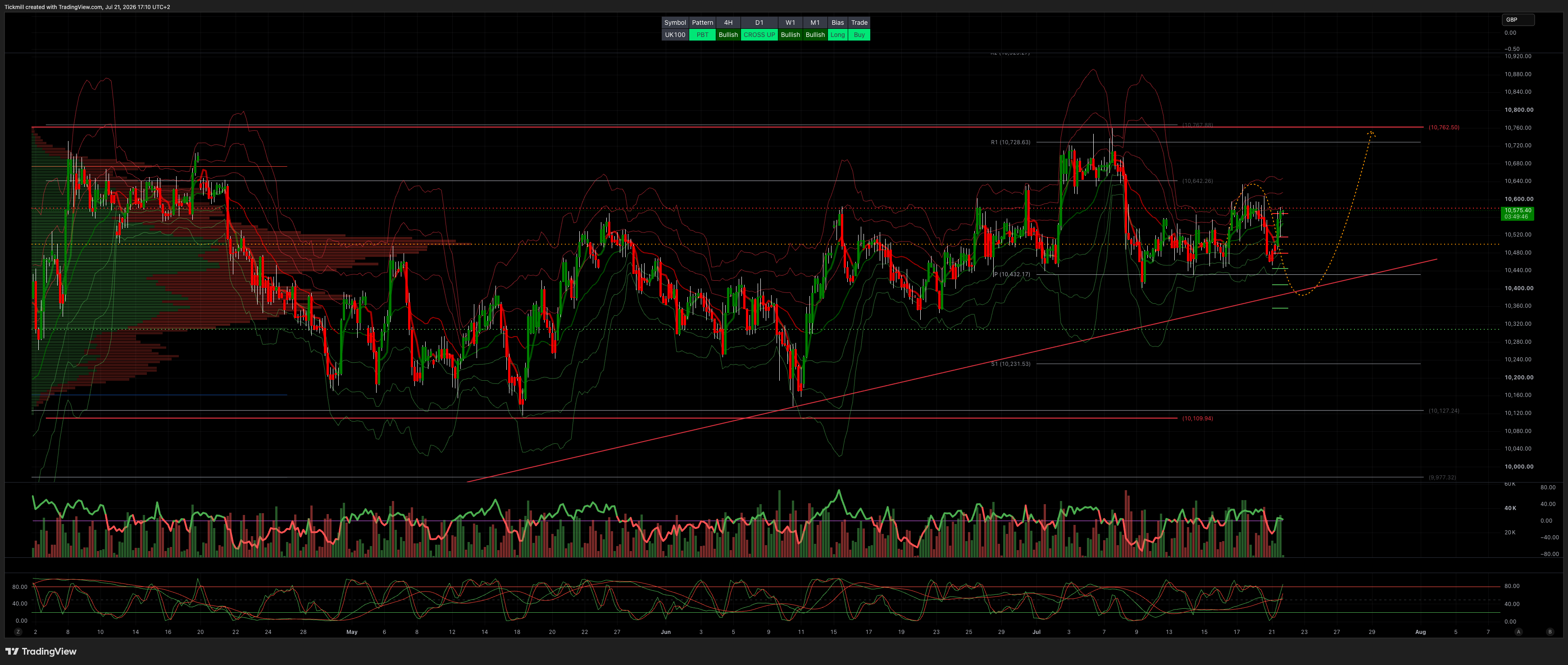
TECHNICAL & TRADE VIEW – FTSE100
Daily VWAP Bearish>Bullish
Weekly VWAP Bullish
Above 10300 Target 11000
Below 10100 Target 9469
Disclaimer: The material provided is for information purposes only and should not be considered as investment advice. The views, information, or opinions expressed in the text belong solely to the author, and not to the author’s employer, organization, committee or other group or individual or company.
Past performance is not indicative of future results.
High Risk Warning: CFDs are complex instruments and come with a high risk of losing money rapidly due to leverage. 68% and 74% of retail investor accounts lose money when trading CFDs with Tickmill UK Ltd and Tickmill Europe Ltd respectively. You should consider whether you understand how CFDs work and whether you can afford to take the high risk of losing your money.
Futures and Options: Trading futures and options on margin carries a high degree of risk and may result in losses exceeding your initial investment. These products are not suitable for all investors. Ensure you fully understand the risks and take appropriate care to manage your risk.
Patrick has been involved in the financial markets for well over a decade as a self-educated professional trader and money manager. Flitting between the roles of market commentator, analyst and mentor, Patrick has improved the technical skills and psychological stance of literally hundreds of traders – coaching them to become savvy market operators!