Institutional Inisghts: Jackson Hole & Credit Spread Stress

JACKSON HOLE & CREDIT SPREAD STRESS
THE TAKE: WARSH’S DISCIPLINE vs. A DEPENDENT MARKET
The upcoming Jackson Hole Economic Policy Symposium—centred on "Financial Innovation: Implications for Payments and Policy"—is shaping up to deliver less explicit guidance than the market wants.
With money markets split (~40% probability of a September rate hike vs. rate-patience following softer PCE data), Fed Chair Kevin Warsh is expected to maintain his strategic preference for reduced forward guidance. Morgan Stanley underscores that Warsh views post-FOMC volatility not as a signal to over-explain, but as proof that markets are overly reliant on central bank hand-holding. Unless macro data forces his hand, expect deliberate ambiguity.
CROSS-ASSET DYNAMICS: GOLD & HEDGING STRATEGIES
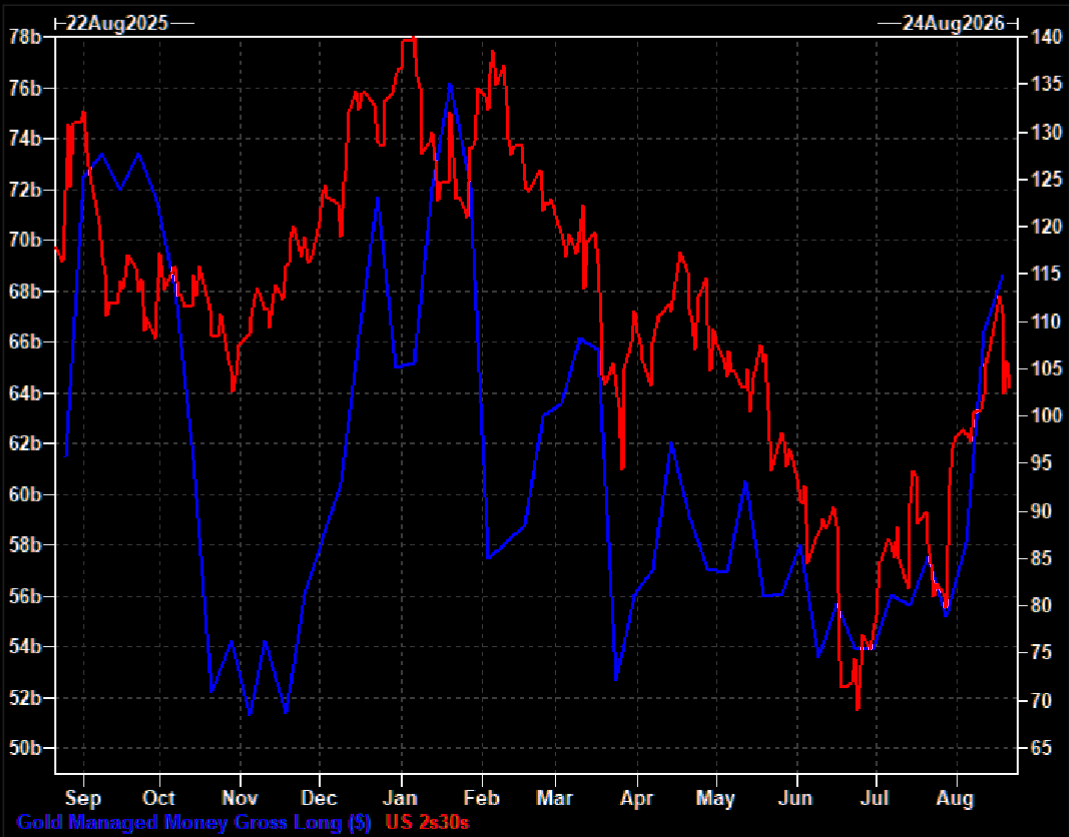
Gold ($4,500 – $5,000 Range): While stretched momentum makes short-term consolidation likely, JPMorgan remains constructive, noting that a cooler macro backdrop + Jackson Hole ambiguity could drive gold toward $5,000 as early as next week. Given January’s massive ~$1,100 single-month rally, another leg higher remains a distinct possibility.
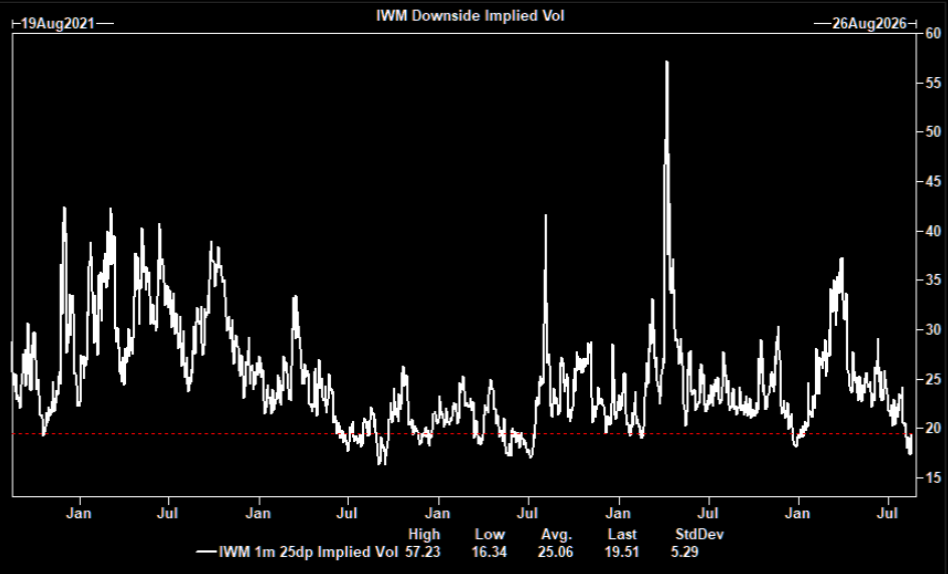
Option Overlay (Goldman Sachs): GS recommends IWM put spreads (September expiry) to exploit 5-year lows in implied volatility. This provides asymmetric downside protection across a dense catalyst window: Fed Minutes, Jackson Hole, NFP, CPI, and the September FOMC.
EQUITY PERFORMANCE DURING CREDIT STRESS (HY SPREADS +100 BPS IN 3 MONTHS)
When High Yield (HY) credit spreads widen rapidly by +100 bps or more over a 3-month rolling period, equity performance exhibits significant factor rotation and drawdowns. Below is the historical performance blueprint across major indexes during these credit stress episodes:
Equity Index / Asset Class | Avg. 3-Month Performance | Avg. 6-Month Performance | Max Drawdown Trajectory | Primary Driver / Risk Dynamics |
Russell 2000 (RTY - Small Caps) | -12.4% | -8.2% | -18.5% | High leverage, refinancing wall sensitivity, default risk |
S&P 500 (SPX - Large Caps) | -6.8% | -1.5% | -11.2% | Quality balance sheets buffer credit shock; margin compression |
Nasdaq-100 (NDX - Tech/Growth) | -5.2% | +2.4% | -12.8% | Initial liquidity drain followed by secular growth bid |
S&P 500 High Dividend / Value | -3.1% | +1.8% | -7.4% | Strong cash flow generation acts as safe-haven equity proxy |
US Investment Grade Credit | -1.8% | +3.2% | -4.1% | Spreads widen initially, but duration bid provides offset |
PORTFOLIO IMPLICATIONS
Prepare for Volatility in RTY: Small caps suffer the largest drawdowns when credit conditions tighten, validating Goldman's recommendation for IWM downside options.
Gold as a Structural Hedge: Treat gold corrections toward $4,500 as accumulation zones rather than structural trend breaks.
Avoid Chasing Fed Guidance: Structure trades around volatility and convexity (strangles, put spreads) rather than directional bets on Warsh's speech.
Disclaimer: The material provided is for information purposes only and should not be considered as investment advice. The views, information, or opinions expressed in the text belong solely to the author, and not to the author’s employer, organization, committee or other group or individual or company.
Past performance is not indicative of future results.
High Risk Warning: CFDs are complex instruments and come with a high risk of losing money rapidly due to leverage. 68% and 74% of retail investor accounts lose money when trading CFDs with Tickmill UK Ltd and Tickmill Europe Ltd respectively. You should consider whether you understand how CFDs work and whether you can afford to take the high risk of losing your money.
Futures and Options: Trading futures and options on margin carries a high degree of risk and may result in losses exceeding your initial investment. These products are not suitable for all investors. Ensure you fully understand the risks and take appropriate care to manage your risk.
Patrick has been involved in the financial markets for well over a decade as a self-educated professional trader and money manager. Flitting between the roles of market commentator, analyst and mentor, Patrick has improved the technical skills and psychological stance of literally hundreds of traders – coaching them to become savvy market operators!